Picanha is one of the most flavourful cuts of beef you can throw on a grill, and it’s still underpriced at most butchers because not enough people know what it is. I’ve been cooking it for years, and it’s become my go-to when I want something impressive without a lot of fuss. Sliced thin against the grain and topped with chimichurri, it’s hard to beat.
This recipe works well for a weekend cookout, a casual dinner party, or any time you want to put something a bit different on the table without spending ribeye money. It’s also great for feeding a group — one roast easily feeds four people, and the chimichurri can be made hours ahead.
No time to read the recipe? Pin it to read later ⤵️

What You’ll Need
Picanha roast (whole, 2–2.5 lbs): Ask your butcher for the whole picanha, sirloin cap, or coulotte — these are all the same cut. The important thing is buying it whole with the fat cap intact. Pre-cut “picanha steaks” at the supermarket are usually too thin and often have the fat cap trimmed down to nothing, which defeats the whole purpose. You want a fat cap that’s at least a quarter inch thick across the whole top of the meat. I’ve made the mistake of picking up a pre-cut pack once and wondered why it came out so flat in flavour — the fat cap is where most of the character lives on this cut.
Kosher salt: Go coarse. The salt grains get down into the score lines on the fat cap and draw out moisture in a way fine salt just doesn’t. I always reach for Diamond Crystal kosher — it’s less dense than Morton’s so it’s harder to over-salt by eye.
Fresh flat-leaf parsley: This is the backbone of the chimichurri. Curly parsley works in a pinch but the flavour is more muted and slightly bitter by comparison. I once tried it side-by-side and the flat-leaf version was noticeably sharper and greener.
Red wine vinegar: The acid that makes the chimichurri cut through the richness of the beef. White wine vinegar is a bit too mild and apple cider vinegar changes the flavour profile enough that it starts to taste a bit like salad dressing.
Shallot: Most chimichurri recipes skip the shallot and go straight for raw garlic. Adding a small shallot gives you a softer, sweeter allium note underneath the garlic punch, and it doesn’t have that raw bite that can overwhelm once the sauce sits for a while.
Other ingredients: fresh oregano, garlic cloves, red pepper flakes, extra virgin olive oil, black pepper.
Ingredient Substitutes
Picanha → Tri-tip: If you absolutely cannot find picanha or coulotte at your butcher, tri-tip is the closest you’ll get in terms of strong beef flavour, lean-ish texture, and the way it behaves on a hot grill. It doesn’t have the fat cap, so you’ll lose that self-basting quality — but the flavour holds up. I’ve cooked tri-tip with this exact chimichurri and it’s a solid meal.
Fresh parsley → Fresh cilantro or a 50/50 blend: Some chimichurri recipes are cilantro-forward and that’s entirely legitimate — it’s more of an Argentinian versus some other South American regional thing. I haven’t tested full cilantro-substitution on this specific recipe, but I’ve had readers report it works well for a brighter, more citrus-forward sauce. The parsley version is what I keep coming back to personally.
Red wine vinegar → Sherry vinegar: Sherry vinegar has more depth and a faint nuttiness that pairs really well with beef. I’ve used it when I’ve run out of red wine vinegar and the chimichurri comes out noticeably richer — not necessarily better, just different. If you have it in the pantry, it’s worth trying.
Garlic powder in the rub → Smoked garlic powder: A swap I started making about a year ago. The smoked version adds an extra layer without needing a smoker, and it plays well against the herby freshness of the chimichurri. I use it anytime I’m doing a quick grill rather than a longer smoke cook.
How to Make Picanha Steak with Chimichurri
Step 1: Make the Chimichurri First
Chimichurri needs time. The garlic needs to mellow a little in the vinegar and oil, and the herbs need to release their oils. I always make it at least 30 minutes before cooking — ideally an hour. If you make it right before serving it tastes a bit raw and bitey.
Finely chop the parsley and oregano — and I do mean finely. Chunky chimichurri, where you get a mouthful of whole parsley stems, is not what you’re after here. Mince the garlic and dice the shallot small, combine everything in a bowl, and stir. The texture should be wet and loose, but not so oily that it’s just green puddles. Cover and leave at room temperature while you prep and cook the steak.
Step 2: Prep the Picanha
Take the roast out of the fridge 30 minutes before cooking — this matters more on a thick cut like this than on a thin steak. A cold center makes it harder to hit medium-rare evenly.
With a sharp knife, score the fat cap in a crosshatch pattern with lines about an inch apart. Cut through the fat but stop just before you hit the muscle — go too deep and the steaks can curl up when they hit the hot grill. This scoring is what lets the seasoning penetrate and the fat render without buckling.
Step 3: Slice into Individual Steaks
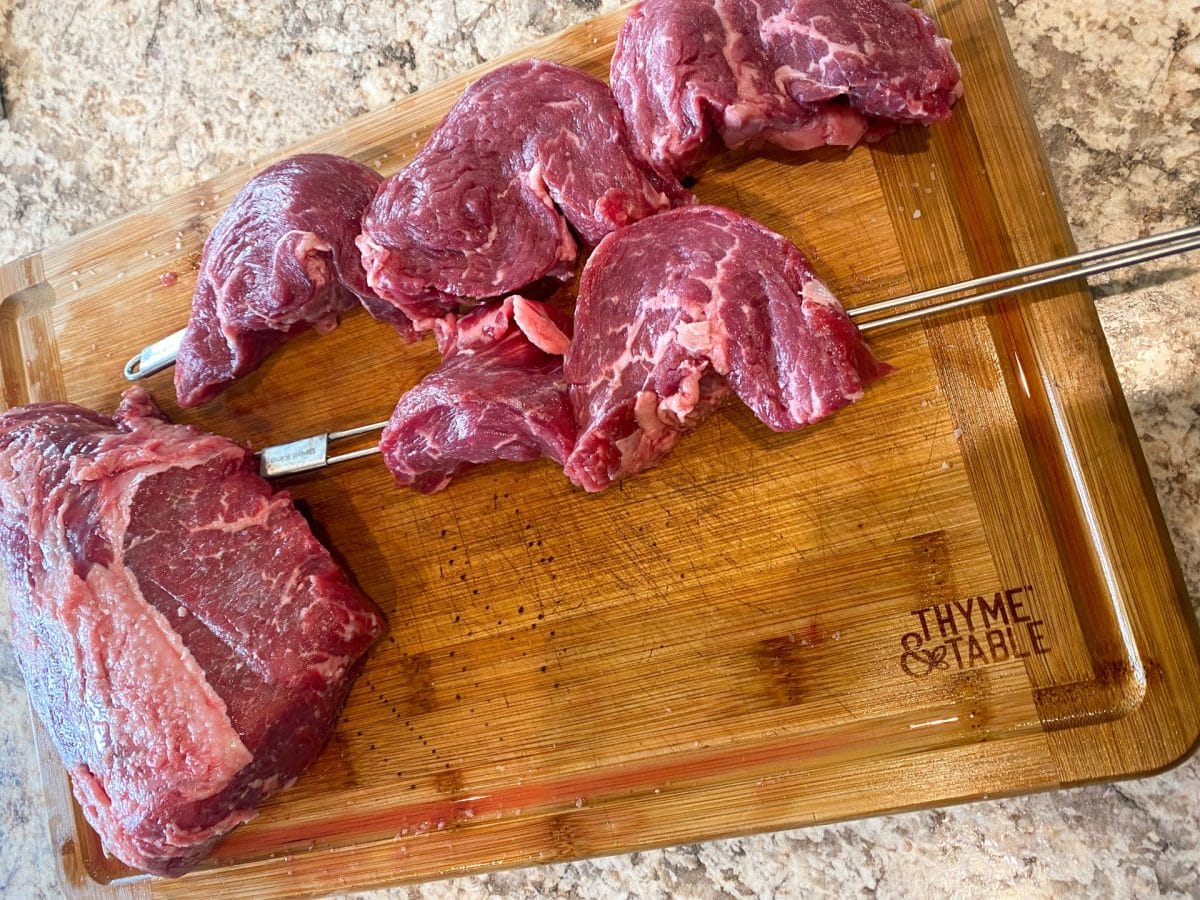
Here’s the move that confuses most people: you slice the picanha with the grain before cooking, not against it. The roast has a clear grain direction running lengthwise. Cutting with the grain gives you individual steaks about 1.5–2 inches thick — I usually get three generous steaks from a 2.5-lb roast, plus a smaller end piece. Each steak will have its own fat cap on top. Place each piece of steak on a skewers.
Use two fingers as a rough guide for thickness — that’s about 1.5 inches and the right size for a proper sear without overcooking the center.
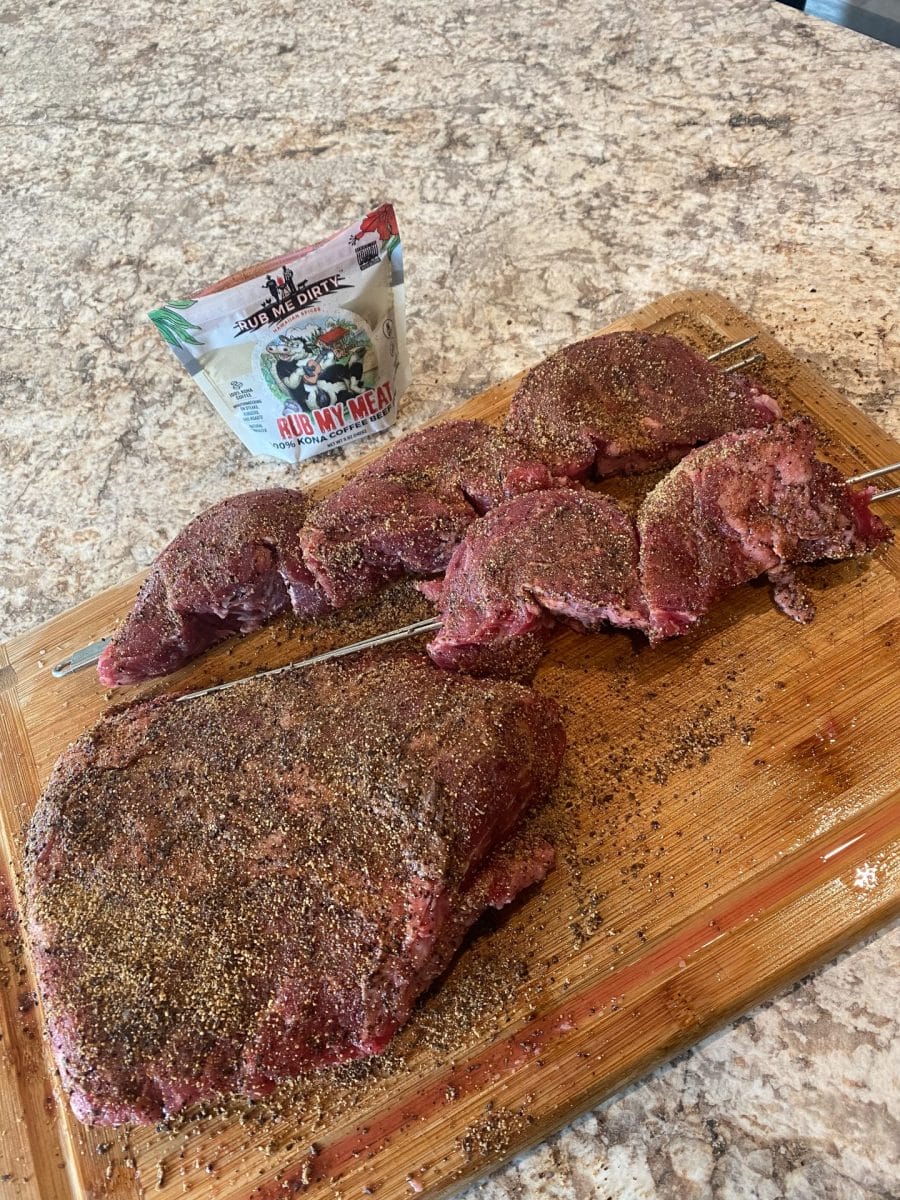
Rub olive oil over the meat side, then season every surface — including the fat cap and the sides — with the salt, pepper, and garlic powder mix. Get the seasoning down into those score lines. Let the meat sit uncovered on a rack for the 30 minutes while the grill heats.
Step 4: Set Up the Grill for Two-Zone Cooking
You need two zones: raging hot on one side for the sear, medium-low on the other to finish the steaks through without burning the fat. On a charcoal grill, bank all the coals to one side. On gas, crank one side to max and leave the other on low.
Give it 10–15 minutes to get the direct side genuinely hot. When you hold your hand 6 inches above the grate and can only manage 2 seconds, it’s ready. If it sizzles hard the moment the steak hits the grate, you’re in business — if it doesn’t sizzle hard on contact, the pan or grill isn’t hot enough and you’ll steam the steak instead of searing it.
Step 5: Sear and Finish
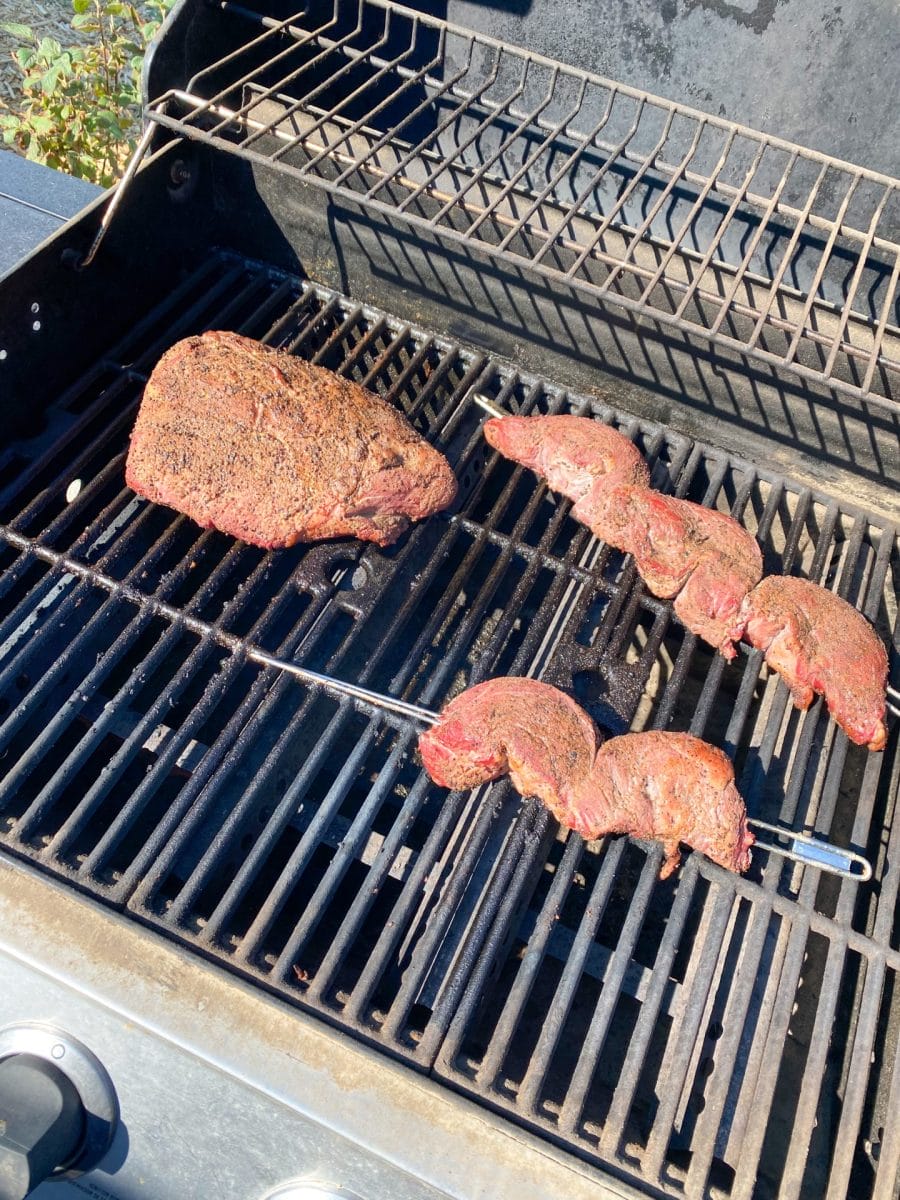
Place the steaks, fat-cap side down, on the direct heat first. You’ll hear an aggressive sizzle and see the fat start to render and drip — some flare-ups are expected and fine. Close the lid to control the oxygen if things get wild. After 2–3 minutes, the fat cap should be deep golden, and you’ll smell that rendered beef-fat smell, almost like butter, going slightly nutty. Flip to the meat side and sear for another 2–3 minutes until color develops.
Move the steaks to the indirect side and close the lid. From here it’s a temperature game — pull them at 130°F for medium-rare, 135°F for medium. Picanha toughens past medium so I’d cap it there. The whole indirect phase takes around 8–12 minutes, depending on thickness.
Step 6: Rest, Slice, and Sauce
Rest the steaks on a board for at least 8 minutes. This is non-negotiable — cut them too early and the juice runs straight out. I tent loosely with foil and use this time to give the chimichurri one last stir and taste for seasoning.
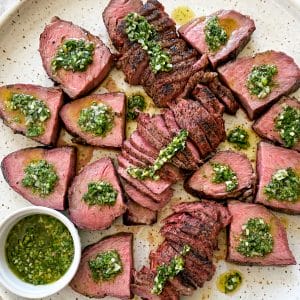
Now slice each steak thinly against the grain — this is the opposite direction to how you cut the raw roast. Thin slices, maybe 1/4 inch. Fan them out on a board or platter, spoon the chimichurri over generously, and serve immediately. That green herbaceous sauce on still-warm beef is one of the better things you can put in front of people.

How to Store Leftovers and Reheat
Let the cooked picanha cool to room temperature before storing — no more than 2 hours out of the fridge. Store sliced leftovers in an airtight container in the fridge for up to 3 days. Keep the chimichurri separate in a sealed jar.
To reheat, warm a skillet over medium heat with a splash of olive oil and briefly sear the slices for 60–90 seconds per side — just enough to warm through without overcooking. The chimichurri is best added fresh at serving. Picanha also freezes well; wrap tightly in cling film and freeze for up to 2 months. Thaw overnight in the fridge before reheating.
My Favorite Wood Chips for Picanha
If you’re adding smoke to this cook on a smoker or a grill with a smoke box, oak is the natural choice — it’s the wood most used in traditional Brazilian churrasco, and it gives a clean, medium-strength smoke that doesn’t compete with the chimichurri.
Cherry adds a subtle sweetness and a beautiful mahogany color to the fat cap. Pecan sits between oak and cherry in intensity and is worth using if you have it. I’d avoid mesquite here — it’s too aggressive for a cut that’s meant to let the beef flavour and fresh sauce do the talking.
Frequently Asked Questions
What is picanha called in the US? Most butchers will know it as sirloin cap, coulotte, or rump cap. Some will have it labelled as top sirloin roast. Always specify you want the whole cut with the fat cap intact — if a butcher tries to sell you a trimmed version, find a different butcher.
Should I cook picanha as a whole roast or slice it into steaks first? Slice it into steaks first — with the grain, to maintain the right thickness — and then grill each steak. Cooking it whole and slicing after works too, but you don’t get the individual sear on the fat cap that makes picanha so good.
What internal temperature should picanha be? Medium-rare is 130°F, medium is 135°F. Stop there. Past 140°F the muscle fibres tighten up and the texture suffers considerably for a cut that thrives on being served pink.
Why does my chimichurri taste too sharp? Either the garlic is too freshly minced with no resting time, or the ratio of vinegar is off. Let it sit for at least 30 minutes before serving and taste again — the sharpness mellows significantly. You can also reduce the garlic cloves from four to three if it’s still too punchy.
Can I cook picanha on a gas grill? Yes, absolutely. Set up two zones — one burner on high, the rest on low — and follow the exact same method. You won’t get the same smoky char as charcoal, but the sear and the two-zone method work identically.
📌 Did you try this recipe?
Have you made this delicious recipe and loved it?
I would love it if you took a minute to leave a star rating and review. It is also helpful if you made any substitutions or changes to the recipe to share that; thank you!
📌 Please also pin the image below, then you can find the recipe for the next time you want to cook.

What to Serve with Picanha Steak
Picanha is big, bold, and rich — you want sides that are either bright and acidic to cut through the fat, or hearty and starchy to complement it.
Smoked Baked Beans
Grilled Broccoli
Baked Sweet Potato
Grilled Cornbread
Smoked Mashed Potatoes
Grilled Carrots with Brown Butter
My suggested complete meal: thinly sliced picanha with chimichurri, smoked cheesy potatoes, and grilled zucchini. Cold beer or a South American Malbec alongside. That’s a proper feed.
Grilled Picanha Steak
Ingredients
For the Picanha:
- 1 whole picanha roast approx. 2–2.5 lbs / 900g–1.1kg, fat cap on
- 1.5 tsp coarse kosher salt
- 1 tsp freshly cracked black pepper
- 1 tsp garlic powder
- 1 tbsp extra virgin olive oil
For the Chimichurri:
- 1 cup fresh flat-leaf parsley finely chopped
- 3 tbsp fresh oregano leaves finely chopped
- 4 garlic cloves minced
- 1 small shallot finely diced
- 1/2 tsp red pepper flakes
- 3 tbsp red wine vinegar
- 1/2 cup extra virgin olive oil
- 1/2 tsp kosher salt
- 1/4 tsp black pepper
Instructions
- Make the chimichurri by combining parsley, oregano, garlic, shallot, and red pepper flakes in a bowl. Add the red wine vinegar and olive oil, season with salt and pepper, and stir to combine. Set aside to rest for at least 30 minutes.
- Remove the picanha from the fridge 30 minutes before cooking. Trim the fat cap to approximately 1/4 inch thick, then score it in a crosshatch pattern without cutting into the meat.
- Rub the olive oil over the meat side, then season generously with the salt, pepper, and garlic powder mix on all sides.
- Slice the roast with the grain into individual steaks roughly 1.5–2 inches thick — you’ll get 3–4 steaks from a standard roast.
- Preheat your grill to high on one side and medium-low on the other for two-zone cooking. You want the hot side above 450°F.
- Sear the steaks over direct heat fat-cap side down first for 2–3 minutes until the fat is golden and rendering. Flip and sear the meat side for 2–3 minutes.
- Move steaks to the indirect side and cook until an internal temperature of 130–135°F for medium-rare, approximately 8–12 minutes depending on thickness.
- Rest the steaks on a board for 8–10 minutes tented loosely with foil.
- Slice each steak thinly against the grain and arrange on a serving board or platter. Spoon chimichurri over generously and serve immediately.
Smoke On!
Charlie

Author: Charlie Reeves
Hi, I’m Charlie, I have been meat-smoking and grilling for the past 15 years. I have an array of different smokers, thermometers, and have a love for finding the right wood and charcoal combo My favourite recipes are my EXTRA CRISPY smoked pork belly, juicy pulled pork, smoked brisket, duck poppers, and ANY SEAFOOD I grill).
I loves sharing his tips with beginners, helping them navigate the world of smoking. I find it’s not just about cooking; it’s a quest for that perfect smoky flavor.
You will usually find me playing with the kids, perfecting my brisket bark, or sipping beers with boys around the fire. Can’t wait to share all my delicious smoking and grilling recipes with you!
You can read more about me on our About Us page.
Hungry For More?